The high-potential output does not supply voltage in the normal state. As soon as an alarm or event occurs, the output supplies a voltage of 12–14 V⎓. The low-potential output works the other way around. In the normal state, the voltage is maintained at 12–14 V⎓, and when an alarm or event occurs, it drops to 0 V.
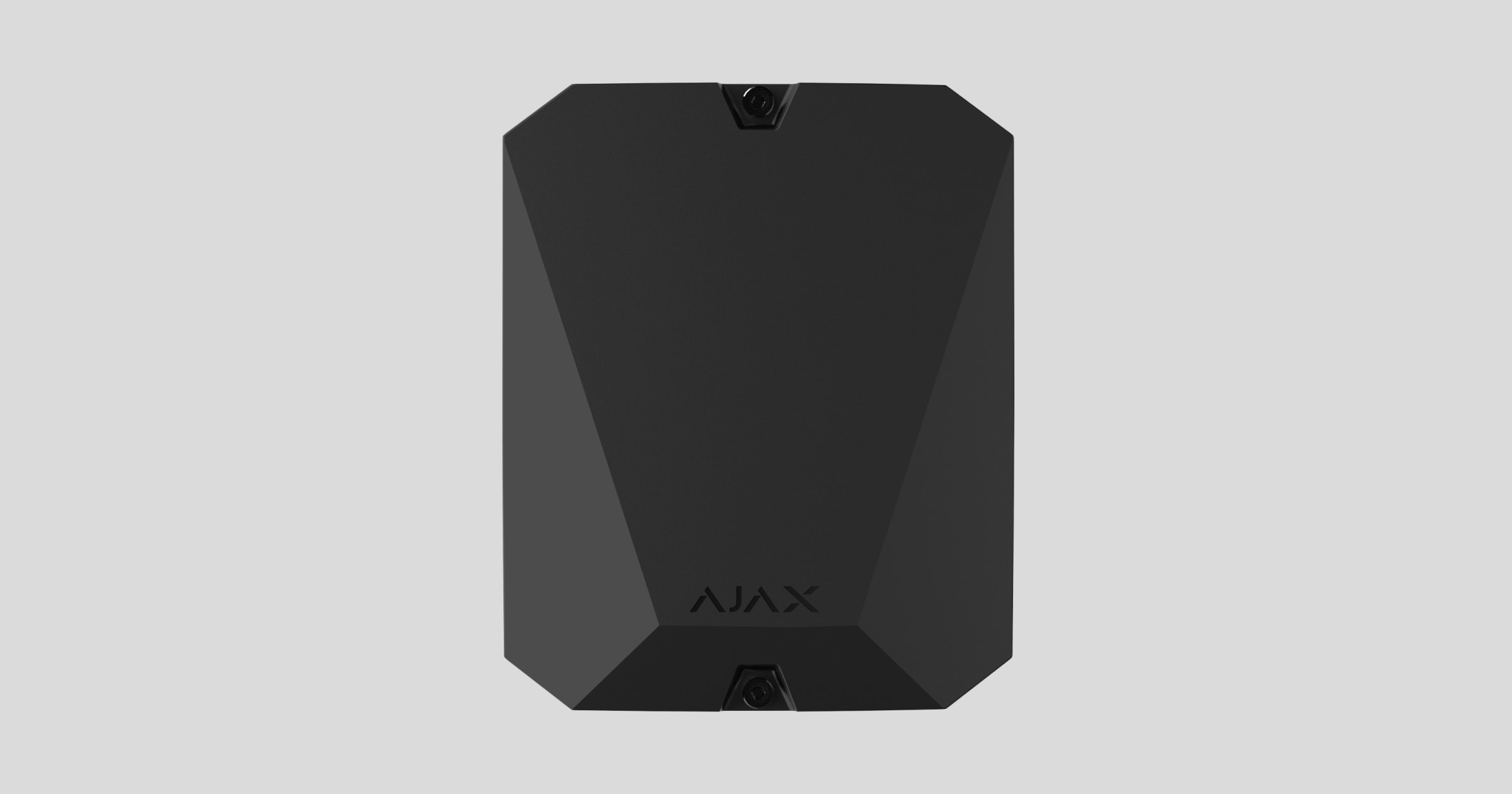

Ajax VHF Bridge
R2508
vhfBridge is a module for connecting Ajax security systems to third-party VHF transmitters. It provides 8 transistor outputs for connection to third-party VHF transmitters.
Description
vhfBridge is a module for connecting Ajax security systems to third-party VHF transmitters. It provides 8 transistor outputs for connection to third-party VHF transmitters.
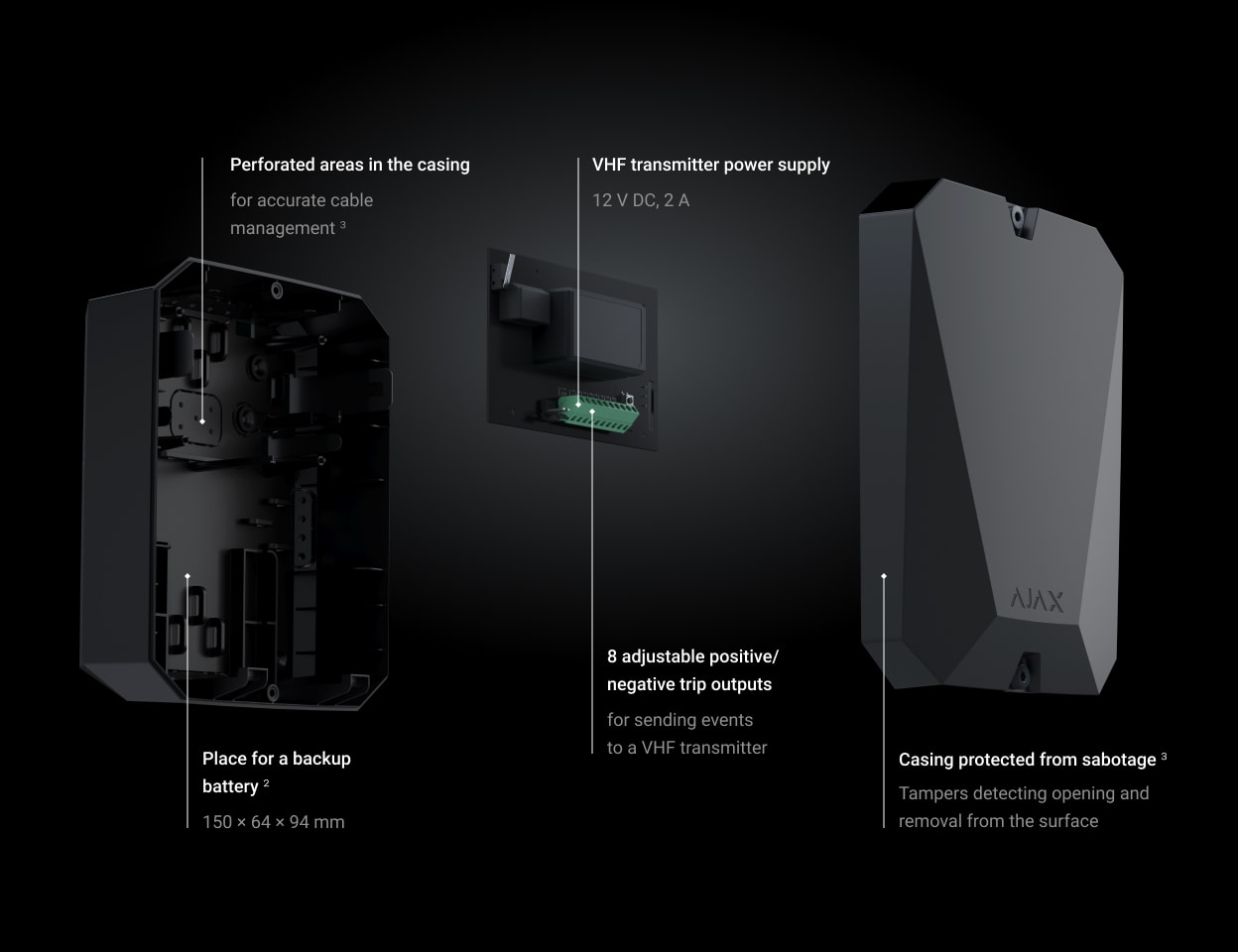
The device is powered from 100–240 V~ mains and can be operated from a 12 V⎓ backup battery.
vhfBridge operates as part of the Ajax security system and connects to the hub via the Jeweller secure radio communication protocol. The hub communication range is up to 1,800 meters without obstacles. Supplied in two configurations: with a casing and without it.
Operating principle
vhfBridge is designed to connect third-party VHF transmitters to create an additional channel for transmitting events to the CMS.
The communication channel with the CMS created using vhfBridge can be used as the only or as a backup channel for communicating with the CMS (recommended more reliable option). This means that the hub can simultaneously transmit all events and alarms to the monitoring station of the security company not only through SIA (DC-09), ADEMCO 685, SurGard (Contact ID), and other proprietary protocols but also using vhfBridge.
The transponder receives information about alarms and events from the hub via the Jeweller radio channel. Then, vhfBridge transmits it to a third-party VHF transmitter via wires. The VHF transmitter, in turn, transmits all events and alarms to the CMS via a radio channel.
Events can be transmitted to the CMS via the Internet and vhfBridge in parallel. Transmission via the Internet works as the main channel because of greater reliability and informativity. The transmitted events may contain the zone number of the triggered detector, group number, user number, and other data.
vhfBridge works as a backup communication channel duplicating all events transmitted via the Internet. The delivery speed of events and alarms in both cases does not exceed 1 second.
An example of the algorithm of actions in case of an alarm from a MotionProtect motion detector:
- MotionProtect has detected an alarm.
- MotionProtect transmits the alarm to the hub via the Jeweller radio protocol.
- The hub receives the MotionProtect alarm and transmits it to vhfBridge via the Jeweller radio protocol.
- vhfBridge receives the alarm from the hub and transmits it to the VHF transmitter over a wired connection.
- The VHF transmitter receives the alarm and transmits it to the radio receiver on the CMS side via the radio channel.
- The radio receiver receives the alarm and transmits it to the CMS software.
- The CMS receives and processes the alarm.
Output types
vhfBridge has 8 potential outputs for connection to a VHF transmitter. There are two types of outputs:
- High potential output (positive trip).
- Low potential output (negative trip).

The vhfBridge output type and alarm pulse duration are configurable in Ajax apps.